
Betting explained
Accumulator Bet Explained and What It Costs You
An accumulator bet rolls several selections into one, and every leg has to win before it pays. That is why a 10 pound five-fold at evens returns 320 pounds, and also why it lands about once in forty-three attempts. This page sets out how the odds build, what the bet actually costs, and what acca insurance is worth once you price it.
 By
By

What an accumulator bet is
An accumulator, or acca, is a single bet made of several selections. The return from each one is staked on the next, so the odds multiply rather than add, and every leg has to win for the bet to pay anything at all. One loser and the whole thing goes.
The legs can come from different matches, different sports and different days. What they cannot usually do is come from the same match, because those outcomes depend on each other, which is a different product priced a different way.
How an accumulator settles
Three steps, and the second is where the money is made or lost.
-
Each leg is settled in turn
A winning leg returns its stake and profit, and the whole of that return is carried to the next leg. Nothing is paid out until the last one is settled.
-
One loser ends it
The moment any leg loses, the bet is dead and the remaining legs are irrelevant. There is no partial payout on a straight accumulator.
-
A void leg shortens the bet
A non-runner or an abandoned match settles at odds of 1.00 rather than losing. A five-fold with one void leg pays as a four-fold, at the four-fold price, off your original stake.
How the odds multiply
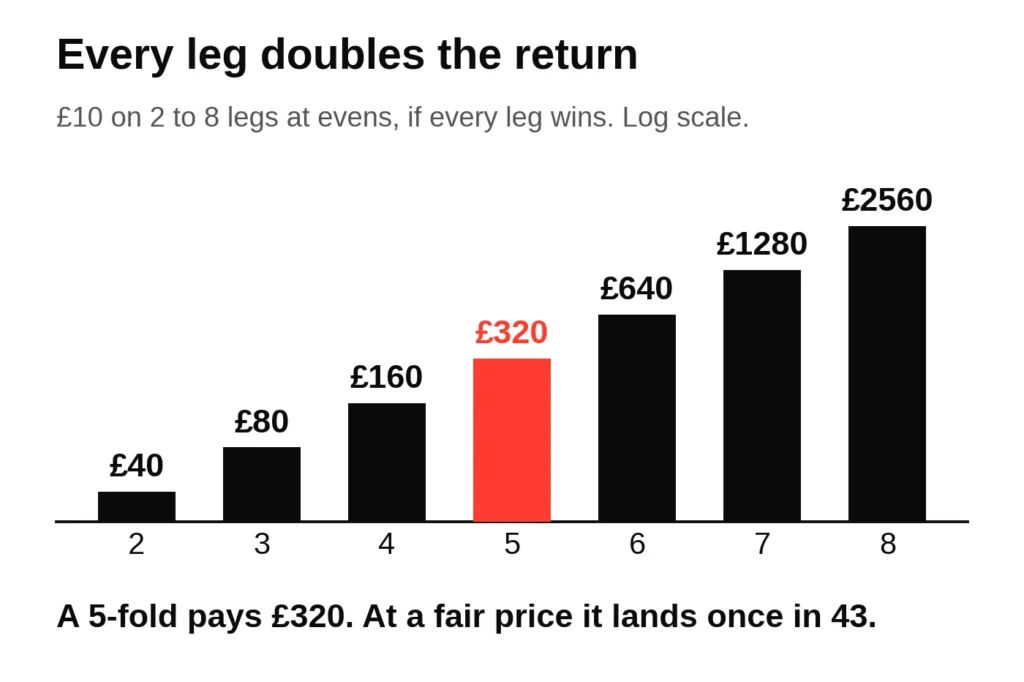
Multiplication is the whole appeal. Five selections at evens is 2.00 to the power of five, which is 32, so a ten pound stake returns 320 pounds. Add a sixth leg and it is 640. Add two more and you are looking at 2,560 pounds from the same tenner.
The reason decimal odds exist is that this arithmetic is trivial in decimals and painful in fractions. If you want the exact number on a real set of prices rather than a round example, our bet return calculator settles every accumulator size and multiple.
Why one leg decides everything
What the return does not show you is the other side of the multiplication. Each leg you add multiplies the payout, and it multiplies the number of ways the bet can die. At a fair price, five legs at evens comes in about once in forty-three. Eight legs comes in about once in three hundred.
This is not an argument against accumulators. It is the shape of the product, and it is why one late equaliser in a match you barely care about takes the entire return with it.
What an accumulator actually costs
The cost is where accumulators stop being a bit of fun and start being the most expensive product on the card. Every leg carries the bookmaker margin, and multiplying the odds multiplies the margin with them.
Across fifty Premier League fixtures we measured an average match-result margin of 6.13 per cent. Compounded over five legs that is about 26 pence of every pound staked, and over eight legs nearly 39 pence. The full arithmetic, and what the same money does over a season, is on our page about the margin built into a price, and the football sample it comes from is on our football betting page.
What acca insurance is actually worth
Acca insurance is the offer that gets accumulators placed. Miss out by one leg and the bookmaker refunds your stake, usually as a free bet, usually capped, and usually only on accumulators of five legs or more.
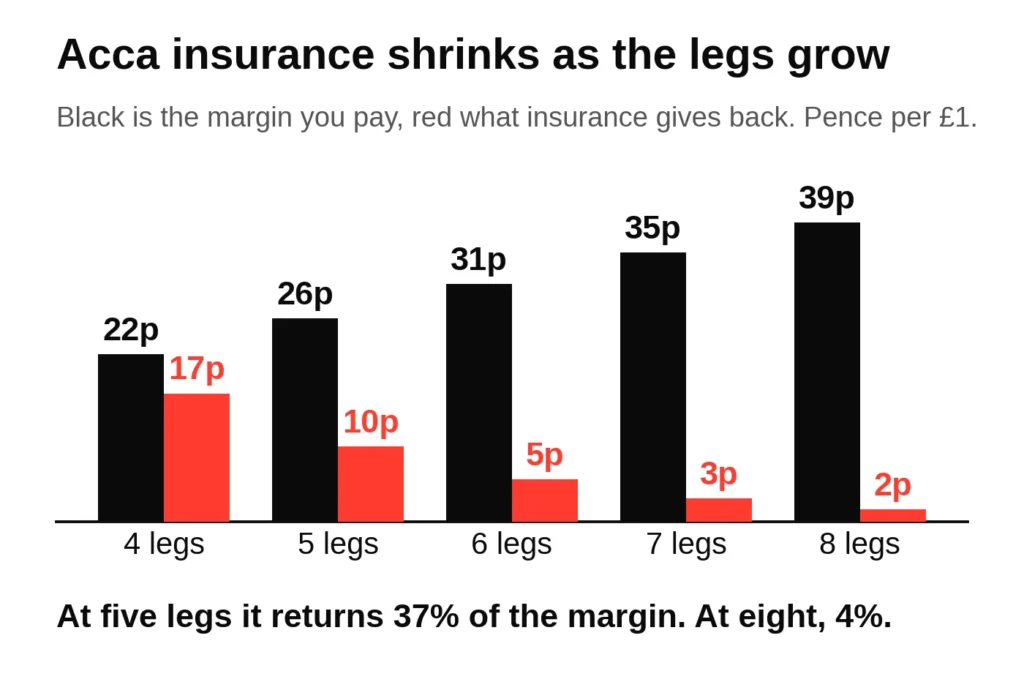
It is worth something real. It is also worth dramatically less than it looks, and the reason is the same multiplication that makes the bet expensive in the first place. Insurance pays when exactly one leg loses, and the chance of exactly one leg losing collapses as you add legs.
Acca insurance, priced
| Four legs | Margin costs 21.6p per pound. Insurance returns 16.5p. It covers 77 per cent of what you are paying, and most books will not offer it at this size. |
|---|---|
| Five legs | Margin costs 26.3p. Insurance returns 9.7p, or 37 per cent. This is the smallest acca most offers accept. |
| Six legs | Margin costs 30.6p. Insurance returns 5.5p, or 18 per cent. |
| Eight legs | Margin costs 38.6p. Insurance returns 1.6p, or 4 per cent. The offer is close to worthless at the sizes it markets hardest. |
| The pattern | Insurance is most valuable on small accumulators and is generally not available on them. Where it is available, its value falls faster than the margin rises. |
The bets that pay when one leg lets you down
If the thing you want is a bet that survives a single loser, an accumulator is the wrong shape and there is a whole family of bets designed for exactly that. A Trixie, a Patent, a Yankee or a Lucky 15 spreads your stake across every combination of your selections, so two winners out of four still return something.
The trade is that you are placing several bets rather than one, so the same stake per line costs more up front. A Lucky 15 is fifteen bets, not one. Which combination fits which situation, and what each one costs per pound, is set out with the arithmetic on our bet calculator. The place terms that apply when you run these each way are covered on our each way betting page.

Acca boosts and what they are worth
Acca boosts are the other standard enhancement, and they are simpler to judge. A boost raises the price of a qualifying accumulator by a percentage that usually grows with the number of legs.
A boost is real money, but it applies to the book price, not to a fair price. A ten per cent boost on a five-fold does not cancel a twenty-six pence margin, it reduces it. The way to read any boost is to convert the boosted price to decimal and compare it against the best price available elsewhere on the same selections, which is the same test described on our page about what betting odds mean.
Accumulator or a multiple bet
- The largest return available from a small stake
- One bet, one stake, nothing to work out at the counter
- Eligible for insurance and boost offers at five legs or more
- A return even when one or two selections lose
- The singles inside a Lucky 15 pay at the cheapest margin on the card
- A stake that is several times larger for the same selections
Cashing out an accumulator
Cash out lets you settle an accumulator before it finishes, for a figure the bookmaker calculates from the remaining legs. It is genuinely useful when four of your five have landed and you would rather take a certain sum than a coin toss.
It is also a second priced market, with its own margin, and that margin is not published. The cash-out figure is always less than the fair value of the bet you are holding, because the book is buying it back from you and charging for the service. Taking it is a decision about how much you dislike variance, not a way to beat the price.

Why there is no best accumulator
People search for the best accumulator bet, and there is not one, for the same reason there is no best price. An accumulator is good when the selections in it are better than the prices being offered on them, and no structure fixes bad selections.
What can be said is what makes accumulators worse than they need to be. Adding legs you do not have a view on, purely to reach an offer threshold, is paying margin for the privilege of qualifying. Taking the first price you see on every leg compounds that error across all of them, because the gap between the best and worst available price is multiplied too. That price gap is the first test every book faces in the best betting sites ranking.
Accumulator questions answered
Convert every price to decimal, multiply them all together, then multiply by your stake. Five legs at 2.00 is 2 to the power of 5, which is 32, so a 10 pound stake returns 320. Our bet return calculator does it for any combination of prices and handles void legs.
A single bet on five selections where all five must win. It is the most common size because it is the smallest accumulator most insurance and boost offers accept. At evens throughout it returns 32 times the stake and, at a fair price, lands about once in 43 attempts.
Every leg has to win, and there is no structural trick that changes that. What you can control is the price you take on each leg and whether you have a genuine view on all of them. Adding a leg you do not have an opinion on to reach an offer threshold lowers the value of the whole bet.
It is worth something, and much less than it appears. On a five-fold it returns about 9.7 pence per pound staked against a margin cost of about 26 pence, so it covers roughly 37 per cent of what you are paying. By eight legs that falls to around 4 per cent, because the chance of losing by exactly one leg collapses as legs are added.
Because it is cheap for them and it encourages larger accumulators. The offer pays only when exactly one leg loses, and that is an increasingly unlikely outcome at the leg counts the offers require. It is also usually paid as a free bet rather than cash, which reduces its value again.
An accumulator is one bet that needs every selection to win. A Lucky 15 is fifteen separate bets across four selections, so one winner still returns something. The Lucky 15 costs fifteen times the stake per line, and that is the price of not losing everything to a single result.
Only if you would rather have a certain amount than the bet you are holding. The cash-out figure carries its own undisclosed margin and is always below the fair value of the remaining bet, so it is a decision about variance rather than a way to get more money out of the position.
As many as you have genuine views on, and no more. Every extra leg multiplies the return and multiplies the margin you pay, and legs added purely to qualify for an offer cost more than the offer returns. The arithmetic on this page is the argument against long accumulators, not for them.