
Betting explained
Each Way Bet Explained and When It Is Worth It
An each way bet is two bets of the same stake on one selection, one to win and one to finish in the places. It costs double, and the place half pays a fixed fraction of the odds, which is where the question of value lives.
 By
By

What an each way bet is
An each way bet is a win bet and a place bet on the same selection, for the same stake, struck together. Ask for 10 pounds each way and the slip takes 20 pounds: 10 on the win and 10 on the place.
The place half pays if the selection finishes anywhere inside the places the bookmaker offers, first included. How many places count, and what fraction of the win odds they pay, are the each way terms. They are printed beside the price and they decide most of what the bet is worth.
- Two bets, one selection, one stake each
- The win half pays at the full odds
- The place half pays at a fraction of the odds, usually 1/4 or 1/5

How an each way bet pays out
There are only three outcomes, and each one settles both halves.
-
It wins
Both halves pay. The win half at the full odds, the place half at the place fraction, because a winner has also finished in the places.
-
It places without winning
The win half loses and the place half pays. Whether that shows a profit depends on the price: at short odds the place return can be less than the 20 pounds you staked on both halves.
-
It finishes outside the places
Both halves lose. An each way bet loses twice the stake of a win bet on the same selection.
Each way place terms
Terms follow the number of runners and the type of race, and handicaps, where the weights are set to even the field out, get deeper terms than other races. The conventional British terms below are where most books start, and many improve on them for big races, which is the whole of the extra places market.
The count that matters is the runners that actually line up, not the runners declared. A race that loses horses at the start can drop into a tier with fewer places, and the bet is settled on the new terms.
The standard UK terms by race
| 2 to 4 runners | Win only. No each way betting. |
|---|---|
| 5 to 7 runners | 2 places at 1/4 the odds. |
| 8 or more runners | 3 places at 1/5 the odds, in races that are not handicaps. |
| Handicaps, 12 to 15 runners | 3 places at 1/4 the odds. |
| Handicaps, 16 or more | 4 places at 1/4 the odds. |
| Golf and outrights | Set market by market and printed beside the price. Books compete on the number of places. |
Working out an each way return
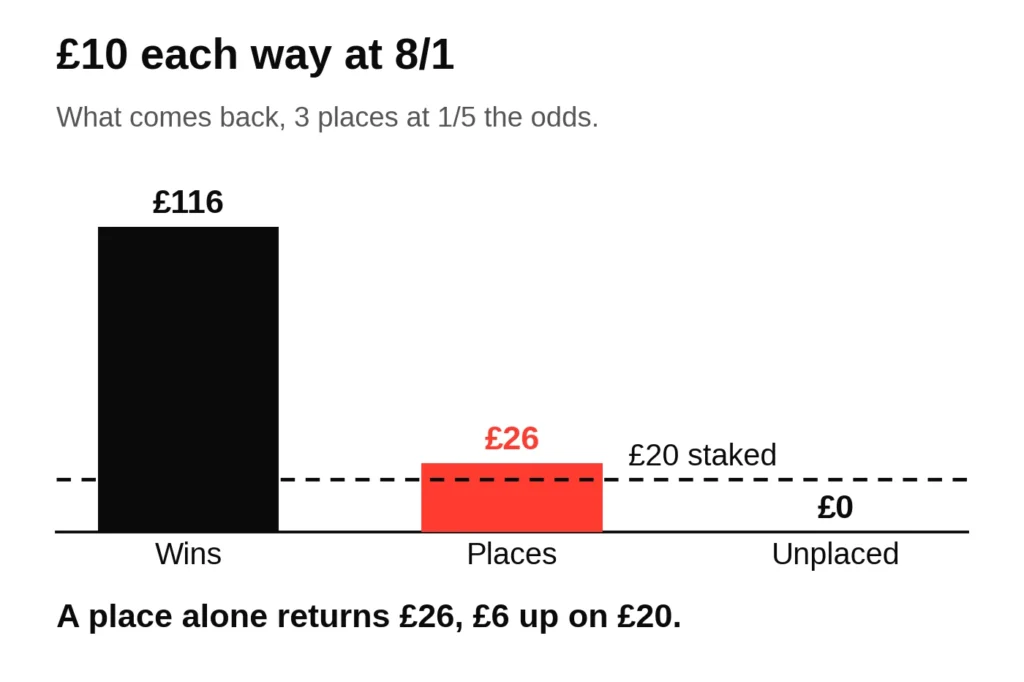
Take 10 pounds each way at 8/1 in an eight-runner race, three places at 1/5. The place odds are 8/1 divided by five, which is 8/5. Each half returns its stake plus its profit.
- Wins: 90 back on the win half and 26 on the place half, 116 in all for 20 staked
- Places: 26 back on the place half, 6 pounds up on the day
- Unplaced: nothing back, 20 pounds down
Every each way bet works the same way: divide the win odds by the place fraction, settle each half on its own, add them. Fractions trip people up more than the method does, and converting them to decimal odds first makes the sum a single multiplication. For multiples, Rule 4 and odds you would rather not work out by hand, our bet calculator settles each way bets of every size.
Each way or a place bet
A place bet is only the second half of an each way bet: one stake, paid if the selection finishes in the places. Some books sell it on its own, usually on horse racing, and exchanges run a separate place market with its own prices. Each way terms are part of the markets test in our UK betting sites ranking.
- Each way: two stakes, pays more when the selection wins, and the place fraction is fixed
- Place only: one stake, pays nothing extra for a win, and the price can move with the market
When an each way bet is worth it
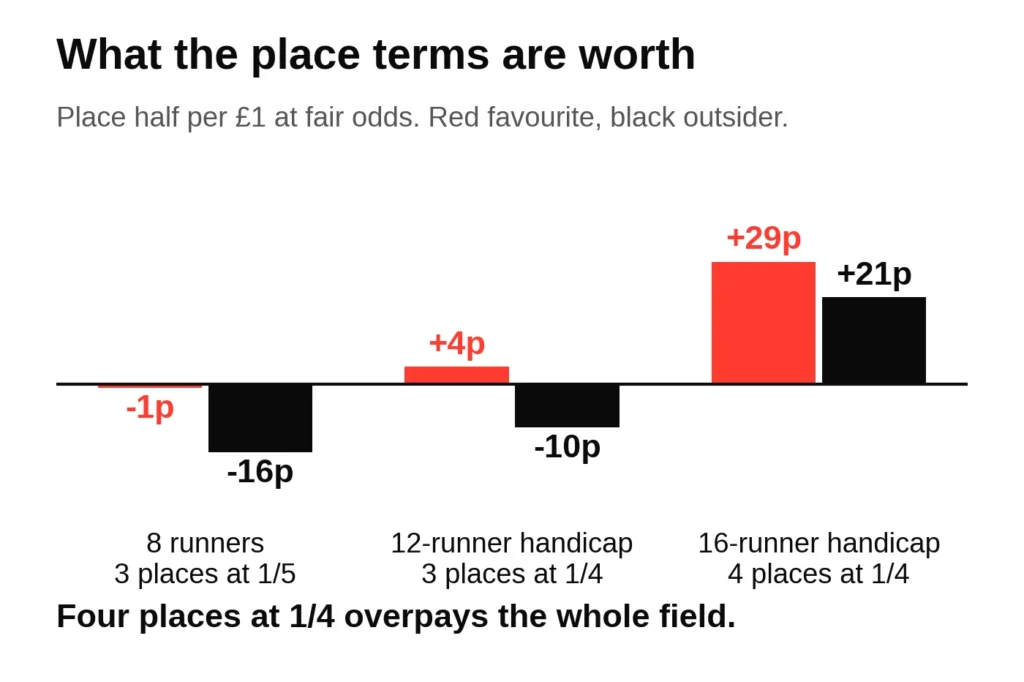
The place half is paid at a fixed fraction of the win odds, and a fixed fraction is not a price. The real chance of placing depends on the whole field, so the same fraction overpays some runners and underpays others. Worked through for three common races at fair odds, the pattern is clear.
- Eight runners, three places at 1/5: the place half is roughly break-even on the favourite and 16p per pound short on an outsider
- Twelve-runner handicap, three places at 1/4: a few pence ahead on the favourite, 10p short on the outsider
- Sixteen-runner handicap, four places at 1/4: 21p to 29p per pound over fair across the whole field
So the terms are most generous where the field is largest and the places run deepest, and least generous on outsiders in small fields, which is exactly where each way is most often used.
Where the book takes it back
The generosity of big-field terms is not a gift. Large handicaps usually carry a bigger overround in the win odds than small races, and that margin is carried straight into the place half, because the place price is a fraction of the win price. The terms decide the shape of the value, and the win price decides how much of it is left.
The practical reading: each way is strongest on shorter-priced runners in big handicaps and weakest on long shots in small fields, and an extra place is worth more than any headline price boost on the same race.
Extra places and enhanced terms
An extra place offer pays the place half one or more positions deeper than the standard terms, most often on big Saturday handicaps and golf. It costs the bet nothing and it only ever adds value, which is why it is the one each way promotion worth checking every time.
- A fifth place in a 16-runner handicap adds a whole finishing position to the place half
- Enhanced fractions, 1/4 instead of 1/5, raise the place price on every runner in the race
- The offer applies at the price you take, so it is worth comparing before the bet, not after

Each way on golf and other outrights
Golf is where each way earns its keep. Fields run well past a hundred players, prices on anyone outside the top of the market are long, and books compete on how deep the places go, so the place half is often where the return comes from. Golf betting markets are priced week by week, and the terms are part of the price.
- Golf: places and fractions vary by book and by tournament, and ties for the last place are settled by dead heat rules
- Football outrights: league winner, top scorer and tournament winner markets offer each way with terms on the market
- Racing futures: ante-post each way bets, struck days or weeks before the race, are settled on the terms and runners on the day
Each way doubles and accumulators
An each way multiple is two multiples, a win one and a place one, each with the full stake. A 10 pound each way double costs 20 pounds: a win double that needs both selections to win, and a place double that needs both to place. The place multiple is what keeps the bet alive when a selection only places, which is the same logic as an accumulator bet built from the place prices.
Full-cover bets double the same way. A Lucky 15 each way is 30 bets and costs 30 stakes, not 15.
Non-runners, Rule 4 and dead heats
Three settlement rules reach into an each way bet in ways a win bet never sees.
- A non-runner is void on both halves and the stake comes back. The runners left may also move the race into a tier with fewer places
- A Rule 4 deduction for a late withdrawal comes off the returns on both halves, not just the win half
- A dead heat for the last place pays the place half at half the stake, because two runners share one position
Racing throws these up far more often than any other sport, which is why the terms and rules sections of horse racing betting matter as much as the prices.
Why bookmakers watch each way punters
The value in each way terms is real, and the British-licensed books know exactly where it sits. Backing short-priced runners each way in eight-runner races, or taking every extra place offer on the day, is the pattern punters most often report before a stake factor, a cut to the most the book will take from you, lands without notice or explanation. The data on why bookmakers limit accounts shows how common and how deep those cuts are.
Books licensed outside Great Britain do not factor stakes in the same way, and for a punter whose edge lives in the place terms, that difference is the whole case for looking beyond the licensed market.
Each way questions answered
It means two 10 pound bets on the same selection, one to win and one to place, so the total stake is 20 pounds.
The place half pays if second is inside the places for that race, which it is in any race with five or more runners. The win half loses.
Divide the win odds by the place fraction to get the place odds, settle the win half and the place half separately, and add the two returns. At 8/1 and 1/5 the place odds are 8/5.
The place half pays if the selection finishes first, second or third. The fraction of the odds it pays is quoted beside the places, usually 1/5 for three places.
It depends on the terms more than the horse. Deep terms in big handicaps and extra place offers make the place half generous; three places at 1/5 on an outsider in a small field usually does not.
No. A place bet is one stake on the place alone. Each way adds a win bet of the same size on top.
If your selection does not run, both halves are void and the stake is returned. If other horses withdraw, a Rule 4 deduction may apply to both halves and the place terms can change with the new field size.
Yes, on outright markets such as the league winner, top scorer and tournament winner. The terms are set per market and shown with the price.