 By
By
Top Choice
1

Gamble Gorilla
- Exclusive Free Bet Offer
- In-Play Live Betting
- Broad Sports Coverage
Bonus
WELCOME SPORTS FREEBET
UP TO £100
FREEBET
UP TO £100
FREEBET

Football
The best football betting sites are the ones that take a smaller cut of every market you bet into, and keep taking your bet once you start winning. This page ranks them on price first, then on the markets, limits and payout behaviour that decide what you actually keep.














Most football rankings count features. We price markets. A bookmaker with forty market types and a fat margin on all of them is worse for you than one with twenty and a thin margin, and no amount of live streaming makes up the difference over a season. (Punters usually shorten bookmaker to book, and so does the rest of this page.)
The ranking above is built on four things, weighted in this order.
The margin built into the odds, measured market by market rather than taken from a headline claim. This decides your long-run return more than everything else combined.
What the book will actually lay you, and how quickly that number falls once you show a profit. A generous price you cannot get on is worth nothing.
How long money takes to leave the account, and what triggers a hold, as each book’s own terms set it out.
Whether the book prices the markets you actually bet, including the ones beyond the match result where the margin is often thinner.
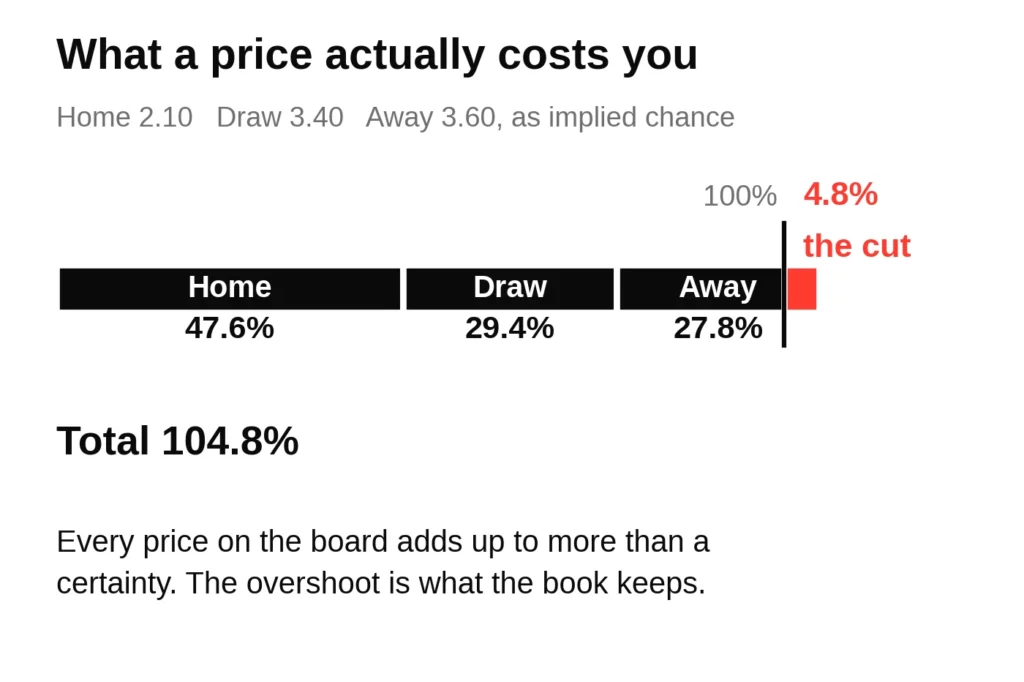
A football price is not a probability. It is a probability with the bookmaker’s cut folded into it, and the cut is invisible unless you add the market up.
Convert each price to its implied chance by dividing one by the decimal odds, then add the three results together. A market with no margin totals 100%. A real one totals more, and the overshoot, the overround, is what the book expects to keep on every bet you place, win or lose.
It compounds quietly across a season in a way a single losing bet never makes obvious. If the mechanics of reading a price are new, we cover them properly in how betting odds work.
TOOL
Type in the decimal odds a book is showing for every outcome of one market. For a two-way market such as over and under 2.5 goals, leave the third box at zero.
Bookmaker margin 4.8% Prices add up to 104.8%
| Outcome | Fair odds | Chance implied |
|---|---|---|
| Home | 2.20 | 45.4% |
| Draw | 3.56 | 28.1% |
| Away | 3.77 | 26.5% |
At these prices the bookmaker builds in a 4.8% margin. On a GBP10 bet that is worth about GBP0.46 to them on average — roughly GBP119.29 a year at 5 bets a week.
The calculator spreads the margin evenly across outcomes. Bookmakers rarely do. Most of the cut is loaded onto the less likely result, so a bet on a heavy favourite is usually better value than the headline margin suggests, and a bet on a long shot is usually worse.
Margin is not spread evenly across a betting site. The match result window on the front page is the most competitive market in football, so it is priced keenest. The markets a casual punter drifts into afterwards are where the real cut sits.
Across our 50-fixture sample, the six bookmakers priced the match result at an average margin of 6.28%, with a median of 6.20%. The spread between them was wider than most punters would guess.
| Keenest bookmaker in our sample | 5.54% margin. About 52p of every 10 pound bet, or 105 pounds across a 200-bet season. |
|---|---|
| A typical bookmaker | 6.28% margin. About 59p a bet, or 118 pounds across the same season. |
| Widest bookmaker in our sample | 7.18% margin. About 67p a bet, or 134 pounds across the same season. |
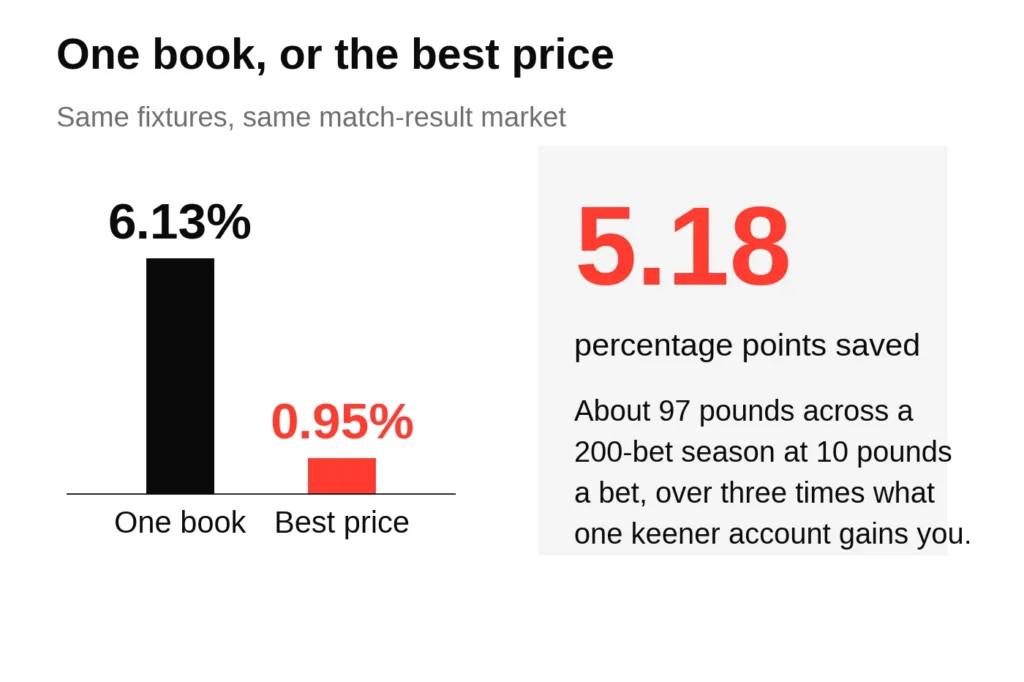
| Best price taken on every outcome | 0.95% margin. About 9p a bet, or 19 pounds across the same season. |
Read the bottom row again. The difference between betting the season with the widest-priced bookmaker in our sample and taking the best available price on each outcome is about 115 pounds on 200 ten-pound bets. The difference between the keenest single bookmaker and the widest is about 29 pounds over the same season. Comparing prices across a few bookmakers is worth roughly four times more than picking the single best one.
That is the whole argument for holding several accounts, and it is why the ranking at the top of this page is a starting point rather than a single answer.
Margin is not a property of a bookmaker. It is a property of a bookmaker and a market together, and the two do not move at the same rate.
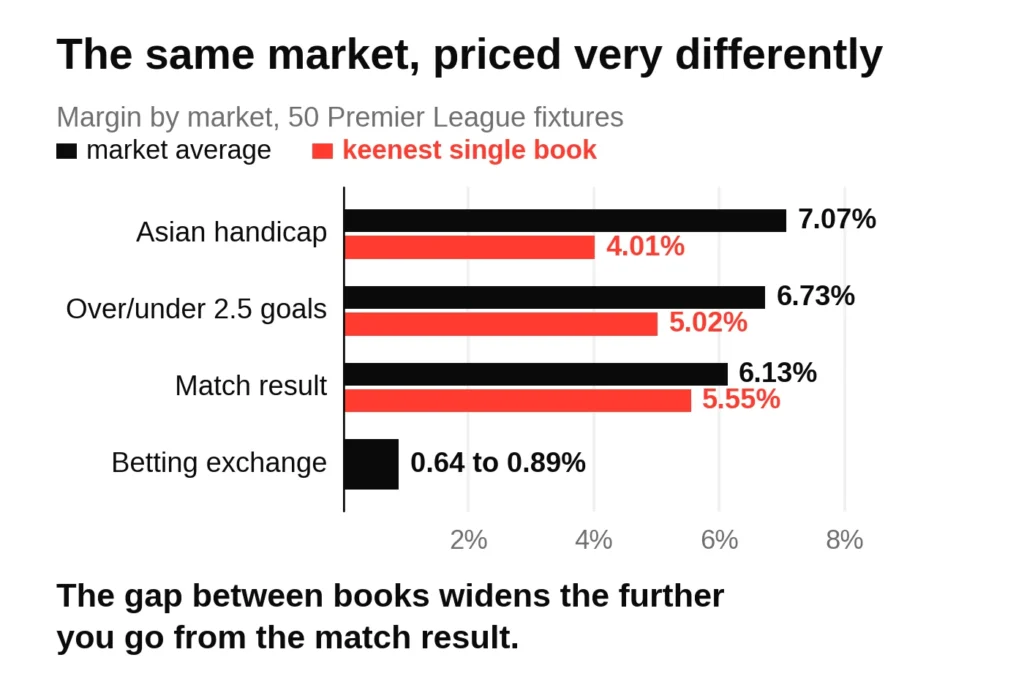
Across the same 50 fixtures the six books stayed close to one another on the match result and drifted a long way apart on everything else. The table below gives both numbers for every market, because one without the other is misleading.
| Match result | 6.13% across the market, 5.55% at the keenest book |
|---|---|
| Over and under 2.5 goals | 6.73% across the market, 5.02% at the keenest book |
| Asian handicap | 7.07% across the market, 4.01% at the keenest book |
| Betting exchange, all three markets | 0.64% to 0.89%, and commission is charged on winnings |
| Gap between the two columns | 0.58 points on the match result, 1.71 on goals, 3.06 on Asian handicap |
Two things fall out of that table.
Asian handicap is not reliably cheap. It is reliably variable, which means it rewards checking a second price more than any other market on the card.
The exchange figures in that table are worth sitting with. On the same fixtures and the same three markets, exchange prices carried a margin of 0.64% to 0.89%, roughly a tenth of what the sportsbooks charged. Commission on winnings closes some of that gap, and liquidity outside the main leagues can be thin, but on Premier League match odds the difference in raw price is not close.
Every book prices the same core markets. What separates them is how many they price in running, how deep they go on lower leagues, and how much margin they hide in the ones punters reach for second.
These are the markets worth knowing, with the cut they typically carry.
| Match result, or 1X2 | Home, draw or away over ninety minutes. The most competitive market on the card and usually the keenest price. |
|---|---|
| Double chance | Two of the three outcomes in one bet. Short odds, and the margin is normally worse than backing the same two separately. |
| Draw no bet | Stake returned if it finishes level. Priced off the match result with the draw removed, so compare it against the Asian line at zero. |
| Asian handicap | A goal start or deficit that removes the draw. The sharpest book priced it near 4%, the market averaged above 7%, so it is the market where a second price pays most. |
| Over and under goals | Usually 2.5, sometimes quarter lines. Margin varies more between books here than on the match result. |
| Both teams to score | A two-way market that should be priced tightly and often is not. |
| Correct score | Dozens of outcomes and a heavy cut. Priced for entertainment, not for value. |
| First and anytime goalscorer | Anytime is the fairer of the two. First scorer carries one of the widest margins on the card. |
| Half time and full time | Nine outcomes, thin liquidity, wide prices. Rarely worth it unless you have a specific read. |
| Cards and corners | Increasingly priced in running. Margins are wide because the data most punters have is poor. |
Double chance, draw no bet, half time and full time, and the cards and corners lines usually get a line each in a football guide. They deserve more, because they are where the pricing is least consistent.
Over and under 2.5 goals looks like the simplest market on the card. It is two outcomes, so it should be priced tightly.
Margin is not a property of a bookmaker; it is a property of a bookmaker and a market together. A book that prices the match result sharply can be mediocre on goals, and the punter who checks only the headline market never finds out.
Asian goal lines work the same way as Asian handicaps. Quarter lines such as 2.25 split the stake across two lines and hand back half on the near miss.
Bet builders look like accumulators on one match, and they are priced very differently: the price you get is lower than multiplying the legs.
The reason is correlation. In a normal accumulator the matches are independent, so the odds multiply. Inside a single match the legs move together.
The more your legs depend on each other, the worse the price relative to the maths. Three loosely related legs will price closer to fair than three that all hinge on the same outcome.
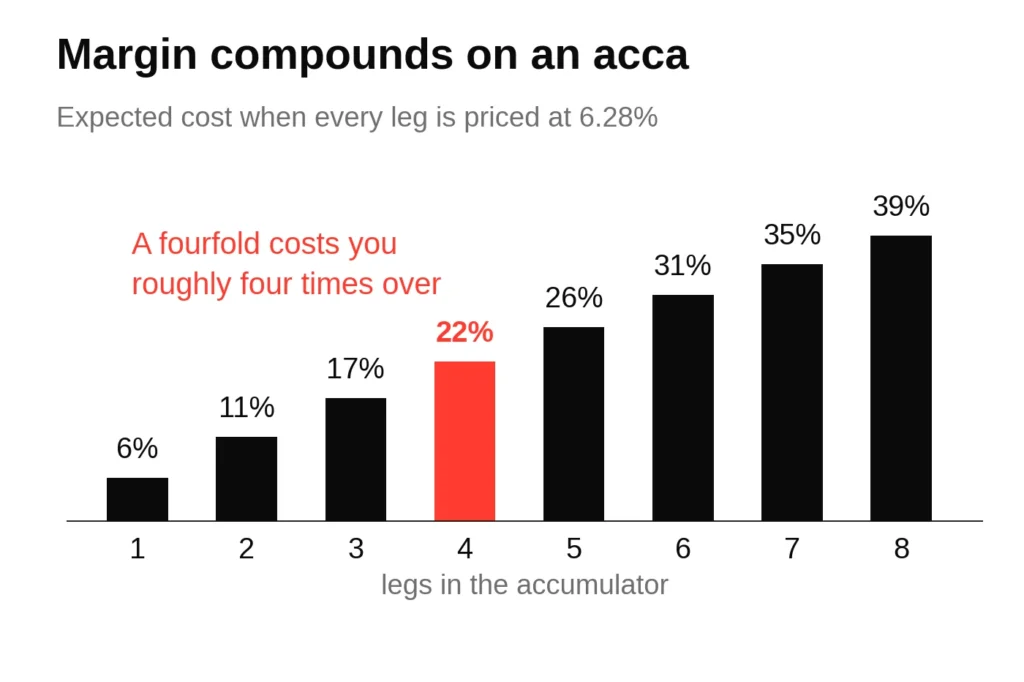
The accumulator is one of the most popular bets in British football, and the one where margin compounds hardest. Each leg carries the book’s cut, and multiplying the odds multiplies the cut with them. At the 6.28% margin we measured on the match result, the share of your stake the book expects to keep grows with every leg:
That does not mean accas are a mistake. It means the price is much higher than the headline margin suggests, and that comparing the price of each leg across bookmakers matters more on an acca than on any single bet.
Acca insurance and boosts push back against this a little. A free bet when one leg lets you down is worth real money if you were going to place the bet anyway. We work through the full mechanics, including the system bets that cover partial results, in our guide to accumulators and multiple bets.
In-play is the hardest part of a football card to price-check, because the price is moving while you look. Liquidity is thinner, and books price defensively because they are managing risk in real time against people who may be watching a faster feed than they are.
Neither is a reason to avoid in-play, but both are reasons to treat the posted margin as a floor rather than a ceiling. There is more on the mechanics in our guide to betting in running.
Live streaming is a genuine convenience and a poor reason to choose a bookmaker. Rights are fragmented, most streams require a funded account or a bet on the match, and the picture is usually several seconds behind the broadcast and further behind the book’s own data.
Treat it as a tiebreaker between two books you would otherwise rate equally, not as a reason to accept a worse price all season. The cost of a wider margin across a year dwarfs the value of the stream.
A price is only worth what you can get on at it, and on football that decides more than the welcome offer ever will.
Bookmakers manage liability by cutting the maximum stake on individual accounts. The account stays open, the markets look normal, and the number in the stake box quietly shrinks, usually first on the markets where sharp money concentrates. The regulator’s figures for 2024 are blunt:
| Stake factoring | A per-account multiplier on the standard maximum bet. The commonest form by a distance. |
|---|---|
| Market restriction | Limits applied to one sport or one market type while the rest of the account looks untouched. |
| Account closure | Less common than factoring, because a closed account stops producing revenue entirely. |
| What triggers it | Beating the closing price, betting early, using odds comparison, and simple profitability. |
| Your appeal route | There is not one. The regulator treats liability management as commercial, and the ombudsman handles individual transaction disputes rather than commercial decisions. |
Best odds guaranteed is a racing convention that has spread patchily into football, usually on outright markets rather than match odds. Where it exists it is worth real money, because it pays you the better of your taken price and the closing price.
Price boosts are a different animal. A boosted price is still a priced market, and a boost from a poor base can land below the standard price elsewhere. Check the boosted number against the best available price on the same selection before treating it as a concession. Our page on best odds guaranteed covers which books apply it to football and on what.
A welcome offer is a one-off. The margin is permanent. That ordering matters, because a book with a generous sign-up and a 7% cut will cost you more by November than a book with a modest offer and a 5.5% cut.
Read three things before claiming any football offer:
We break the offer types down properly on our free bets and sign-up offers page.
Deposits are instant at most books and are rarely a reason to choose one. Withdrawals are where books differ.
The pattern that causes most grief is verification deferred until the first withdrawal. A book that takes deposits for weeks and then asks for documents when you try to take money out has turned a routine check into a delay at the worst moment.
Payout timings by method are covered on our fast withdrawal page.
The Premier League is one of the most heavily traded competitions in world football, and that works in your favour: liquidity is deep, prices are sharp, and books watch each other closely.
It also means the edge is rarely in the match result. In our Premier League sample the books stayed close together on the match result and drifted apart on the secondary markets attached to it.
European nights bring the same markets with less consistent pricing. Books that are sharp on the Premier League are not automatically sharp on a midweek league-phase game between two sides they trade less often.
Our margin sample covers only the Premier League, but the logic carries over: where books trade a fixture less, their prices are more likely to disagree, and comparing them is worth more. Maximum stakes can be lower on these markets too, so the price you find may not be the price you can get on in size.
Depth is where books differ most visibly, and it rarely shows up in a features table. Every UK book prices the Premier League in depth; below that, coverage diverges.
Three things are worth checking before you settle on a book for the rest of your football betting:
Thinner markets are priced by fewer traders with less data, so margins tend to be wider and maximum stakes lower. That is an opportunity if you know a division well, and a cost if you bet it casually on your Premier League stake.
There is no single best football book, because the thing that costs you most depends on what you bet. Match the book to the pattern.
Three common patterns and what each should optimise for.
| Criterion | Weekend acca punter | Single-match bettor | Price first Regular, seeking value |
|---|---|---|---|
| Matters most | Acca insurance and boosts | Market depth in running | Margin and maximum stake |
| Margin exposure | Very high, paid per leg | Moderate | Lowest, if you shop around |
| Restriction risk | Low | Low to moderate | High, and quickly |
| Worth holding several accounts | Helpful | Helpful | Essential |
Restriction risk reflects how books behave toward consistently profitable accounts, not a judgement about any individual operator.
One rule applies to all three. Hold more than one account. The margin figures on this page show that taking the best available price on each outcome cuts the cut from 6.13% to 0.95%, and there is no way to do that from inside a single account, however good that book is. The ranking at the top of this page is a starting point for building that set, not a recommendation to pick one and stop. More on how we assess books across the market at Overround Desk.
Everything above rests on one calculation repeated across a fixed sample, and it is worth setting out in full so you can check it or repeat it on any market you like.
Five steps, no spreadsheet required. The calculator higher up this page does the same arithmetic if you would rather type the prices in.
For a match result that is three prices. For goals or Asian handicap it is two. Use decimal odds. The prices need to come from the same moment, because a market that has moved between quotes is not one market.
Divide one by the decimal odds. A price of 2.10 implies 0.476, or 47.6%. This is the chance the price is charging you for, not the chance the outcome actually happens.
A market with no margin in it totals exactly 1.00, or 100%. Every real market totals more.
What is left is the margin. A total of 1.048 means a margin of 4.8%. That is the proportion of every pound staked into this market the book expects to keep, win or lose.
One fixture tells you nothing. We used 50 English Premier League fixtures played between 21 August and 20 September 2026, calculated the margin for every book on every market, and averaged. The underlying odds are published free by football-data.co.uk, so the whole exercise is reproducible.
It changes by market and by fixture, which is the honest answer and the reason to hold several accounts. In our 50-fixture sample the spread between the keenest and dearest book on the match result was 5.54% against 7.18% margin, but no single book was cheapest on every match. Taking the best available price across books beat every individual book by a wide distance.
Anything at or below about 5% on the match result is competitive for a UK sportsbook. The average across the six bookmakers we measured was 6.28%. An exchange prices the same market under 1%, before commission.
Almost certainly stake factoring. Bookmakers apply a per-account multiplier to the standard maximum, usually after an account shows a profit or a pattern of taking early prices. It is applied silently and there is no formal appeal route in the UK market.
They offer convenience. The legs are shaded downward for correlation, so the price is always below what multiplying the individual legs would give you. The more your legs depend on each other, the bigger that reduction.
It depends where you bet it, more than any other market. At the sharpest book in our sample Asian handicap was the cheapest thing on the card at 4.01%, against 5.55% on that same book’s match result. Averaged across every book quoting it, it was the dearest of the three at 7.07%, against 6.13%. Nothing else we measured swings that far, so an Asian handicap price is worth checking against a second book every time.
To a debit card or e-wallet, same day to two working days once the account is verified. The delays that cause complaints are almost always verification requested at the withdrawal stage rather than at sign-up. Complete your checks when you open the account.
They are the most expensive way to bet football, because the margin is paid on every leg. A fourfold built from 6% markets carries an effective margin over 20%. That is the price of the product rather than a reason to avoid it, but it makes comparing prices on each leg matter more, not less.
If you care about price, yes. The single largest saving available on this page comes from taking the best available price on each outcome rather than accepting one book’s number, and that requires somewhere to take it.